VMC (VISTA survey of the Magellanic Clouds system)
Description
The main goals of the VMC survey are the determination of the spatially resolved star formation history and the three-dimensional geometry of the Magellanic system. Observations were obtained with the VISTA telescope as part of the VISTA survey of the Magellanic Cloud system (VMC; ESO program 179.B-2003) in three filters: Y, J and Ks. The sensitivity of the data is designed to reach sources below the oldest main-sequence turn off point of the stellar population and the multi-epochs to measure accurate Ks mean magnitudes for pulsating variable stars, e.g. RR Lyrae stars and Cepheids.
The vmc_dr7.source and vmc_dr7.psfsource tables have been crossmatched against our default reference datasets (AllWise, GAIA DR3, NSC DR2, SDSS DR17 and unWISE DR1) within a 1.5 arcsec radius, nearest neighbor only. These tables will appear with x1p5 in their name in our table browser.
Examples:
(Using vmc_dr7.psfsource table's coords. as reference:)
vmc_dr7.x1p5__psfsource__gaia_dr3__gaia_source
(Using gaia_dr3.gaia_source table's coords. as reference:)
gaia_dr3.x1p5__gaia_source__vmc_dr7__source
For more info, please visit https://star.herts.ac.uk/~mcioni/vmc/
Data Releases
VMC DR7
This data release is based on the complete observations for the VMC survey and data from twelve additional programs, which add multi-epoch observations to the VMC foot-print. There are 68 VISTA tiles encompassing the Large Magellanic Cloud (LMC), 28 over the Small Magellanic Cloud (SMC), 13 across the Bridge and 2 on the Stream. Observations were acquired between October 2009 and January 2023. This release provides reduced and calibrated tile images belonging to individual observations ('single OBs'), in addition to the corresponding pawprints (6 per tile), deep co-added images, and source lists (separately for each filter). In addition, also deep co-added tile images and catalogues (separately for each filter), for both individual tiles and combined, as well as band-merged catalogues and catalogues with PSF magnitudes, are provided. This release supersedes all previous data releases of the VMC survey for the combined (deepstacked) data products, whilst providing additional (complementary) images and catalogues of single observations per filter. Overall, it includes about 64 million detections, split nearly evenly between sources with stellar of galaxy profiles. There are at least 4 tiles in Y and J filters and 14 tiles in Ks filter per field. The total sky coverage of this release is ~170 deg².
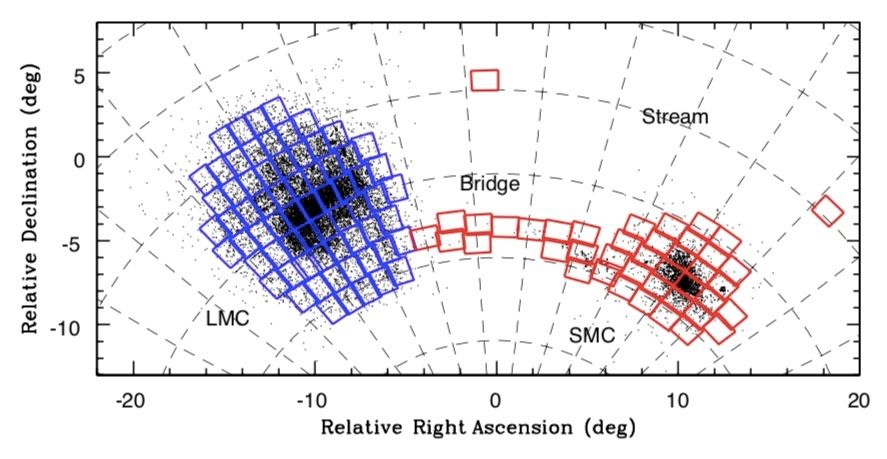
Figure 1: Shows the Magellanic system as tiled by the VMC survey. Underlying small dots indicate the distribution of carbon stars, stellar clusters and associations. Tile numbering begins from the bottom right corner, increasing from right to left and from bottom to top. The first LMC tile is 2_3 whereas the first SMC tile is 2_2, the first Bridge tile is 1_2 and Stream tile 1_1 is right above the Bridge while Stream tile 2_1 is to the right of the SMC. Each survey tile has at least 2 OBs in Y and J filters, respectively (providing 800 s exposure time per pixel each) and 11 OBs in Ks with 750 s exposure time per pixel each. There are also pairs (YJ, JKs, and YKs) of shallow observations corresponding to half the exposure times.
VMC DR7 Tables
| Table | Description | Columns | Rows | More info |
|---|---|---|---|---|
| source | Band-merged sources | 107 | 71,898,188 | VMC data model |
| psfsource | Sources with PSF fitted photometry | 42 | 156,702,048 | VMC data model |
Data Access
The VMC data are accessible by a variety of means:
Data Lab Table Access Protocol (TAP) service
TAP provides a convenient access layer to the VMC catalog database. TAP-aware clients (such as TOPCAT) can point to https://datalab.noirlab.edu/tap, select the vmc_dr7 database, and see the database tables and descriptions. You can also view the VMC DR7 tables and descriptions in the Data Lab table browser.
Data Lab Query Client
The Query Client is available as part of the Data Lab software distribution. The Query Client provides a Python API to Data Lab database services. These services include anonymous and authenticated access through synchronous or asynchronous queries of the catalog made directly to the database. Additional Data Lab services for registered users include personal database storage and storage through the Data Lab VOSpace.
The Query Client can be called from a Jupyter Notebook on the Data Lab Notebook server. Example notebooks are provided to users upon creation of their user account (register here), and are also available to browse on GitHub at https://github.com/astro-datalab/notebooks-latest.