KS4 (KMTNet Synoptic Survey of Southern Sky)
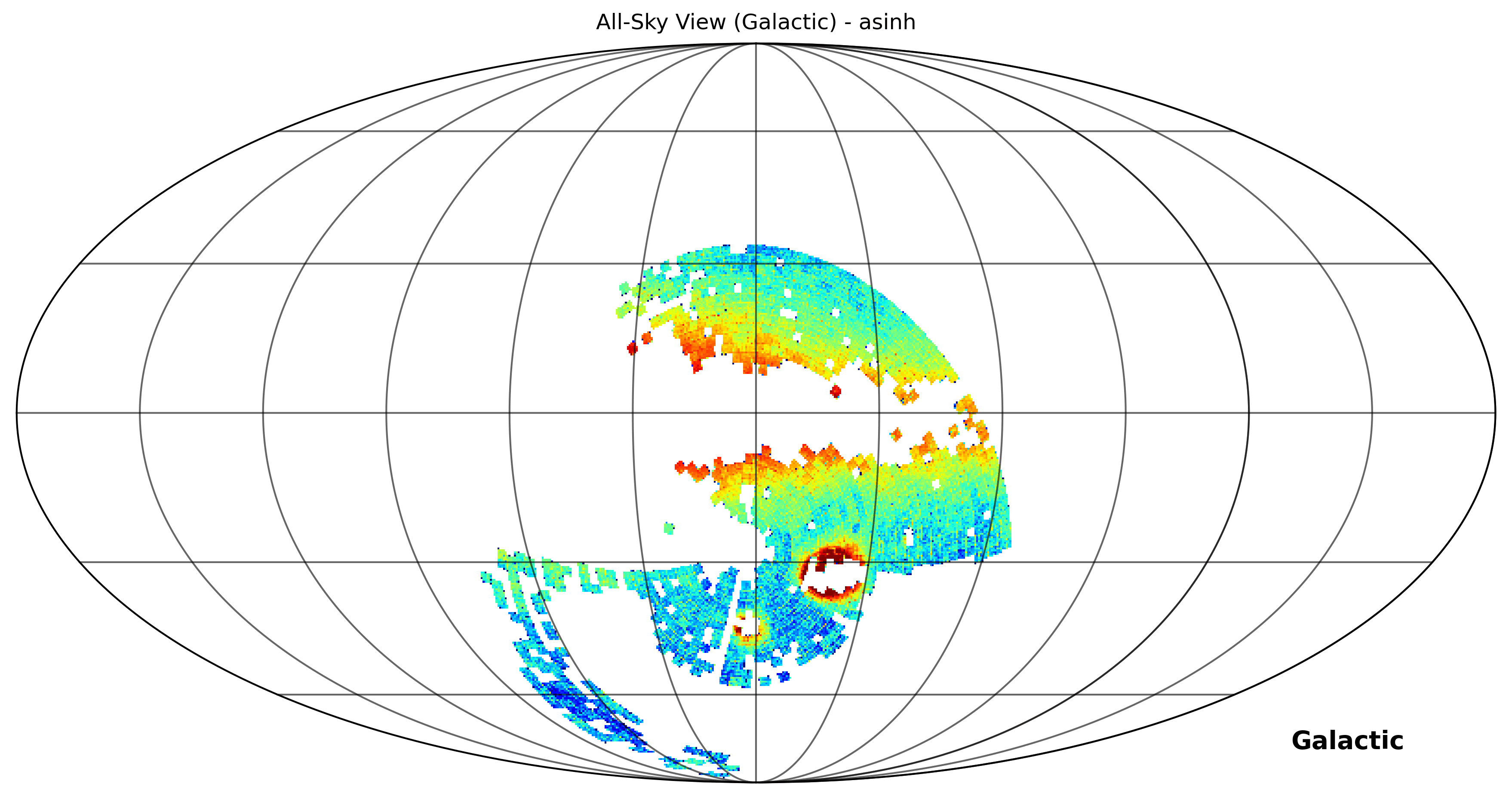
Figure: All-sky map in galactic coordinates displaying KS4's footprint on the sky.
Note: As of June 26, 2026, the coadd_object_id columns in both the idual_master and single_master tables have been updated.
Description
This is the first public data release (DR1) from the KMTNet Synoptic Survey of the Southern Sky (KS4). KS4 is a deep, four-band (B, V, R, I) imaging survey covering a large area of the southern hemisphere (-85° < Dec < -28.8°). KS4 has been conducted using the Korea Microlensing Telescope Network (KMTNet), which consists of three identical 1.6-m telescopes located at Cerro Tololo Inter-American Observatory (CTIO) in Chile, South African Astronomical Observatory (SAAO) in South Africa, and Siding Spring Observatory (SSO) in Australia. The survey started in November 2019 with a goal of obtaining the imaging data up to ~7,000 deg².
The primary science goal of KS4 is to provide deep, wide-field reference images to aid in the identification of optical counterparts to gravitational wave (GW) events. This DR1 provides science-ready data products for approximately 4,000 square degrees.
The data release includes deep co-added images reaching a 5σ limiting magnitude of 22-23.5 AB mag. It also provides two complementary source catalogs containing over 279 million unique objects:
-
idual_master(228.1 million objects): An I-band-selected, forced-photometry catalog optimized for consistent color measurements. -
single_master(279.9 million objects): A band-merged catalog based on independent detections in each filter, optimized for completeness.
For a full description of the data release, the processing pipeline, and data validation, please see Chang et al. 2026 and Jeong et al. 2026.
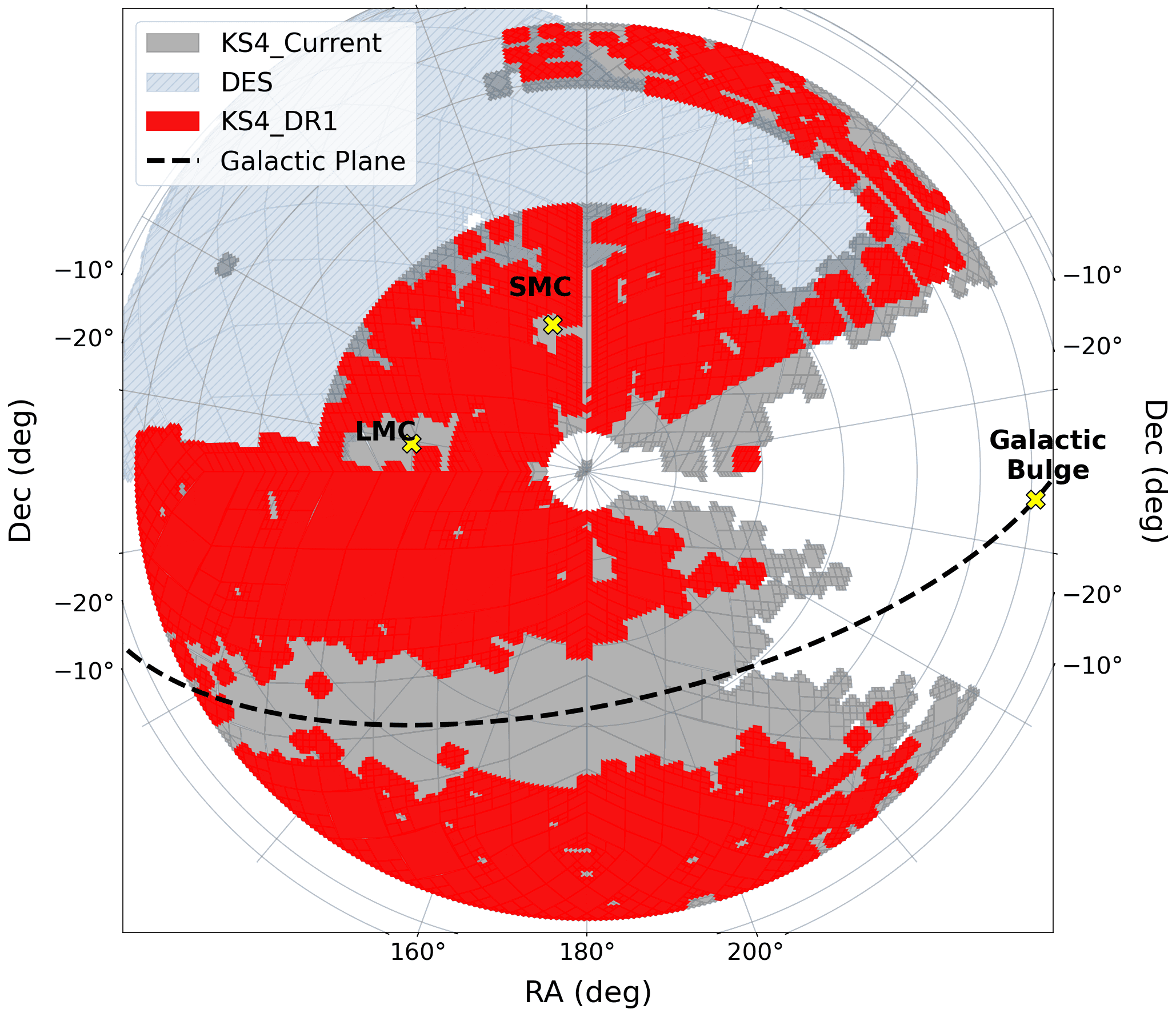
Figure: Multi-Order Coverage map of the KS4 DR1 sky coverage, presented in a polar projection centered on the South Celestial Pole (Decl. = -90°).
Data Releases
KS4 DR1
| KS4 DR1 Summary | |
|---|---|
| Area Covered | ~4,000 deg² |
| Bands | B, V, R, I |
| Median 5σ Depth | B = 22.72 AB mag, V = 22.56 AB mag, R = 22.75 AB mag, I = 22.07 AB mag |
| Median Seeing (FWHM) | B=2.10", V=2.03", R=1.94", I=1.93" |
| Number of Fields | 979 |
| Total Exposures | 17,626 |
| Unique Objects | Over 200 million (SNR > 5) (High-confidence sources: 116,393,930 in B, 140,896,979 in V, 195,153,754 in R, and 202,256,982 in I) |
| Astrometric Accuracy | 0.125" (modal offset vs. Gaia DR3, no proper motion correction) |
| Photometric Homogeneity | Median offsets for point sources within ±0.03 mag (vs. Gaia XP < 19 ABmag) |
| KS4 DR1 Tables | |
|---|---|
| Table Name | Description |
| idual_master | Reference-band catalog based on I-band detections (228,119,100 rows) |
| single_master | Band-merged catalogs based on independent detections in each filter for enhanced completeness (279,909,360 rows) |
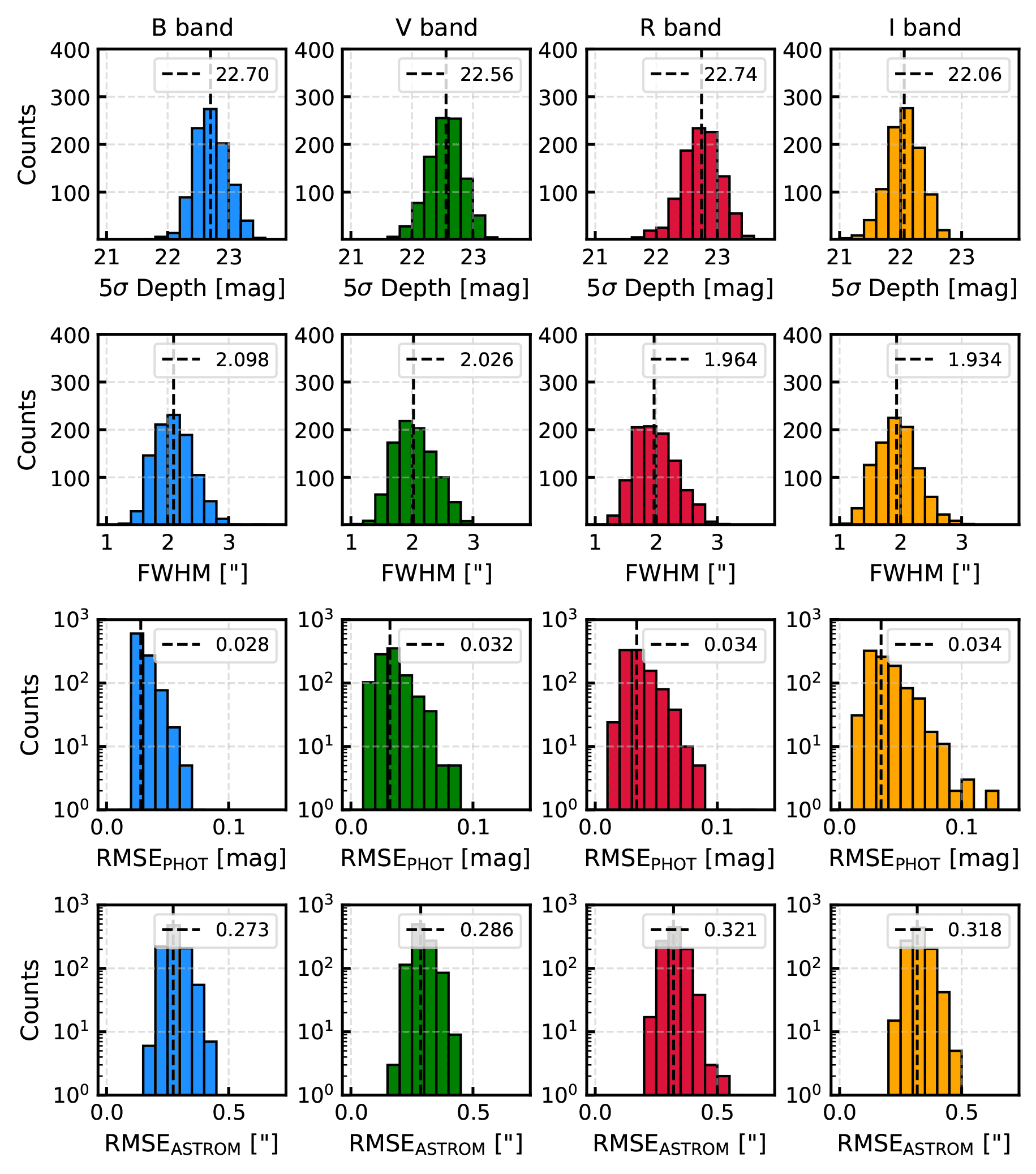
Figure: Essential statistics on depth, seeing, and astrometry for each of the bands covered in this survey (B, V, R, I).
Data Reduction and Calibration
The KS4 DR1 data products were generated using a dedicated pipeline (described in Jeong et al. 2026), which builds upon standard KASI pre-processing. The key steps are summarized below.
| Step | Description |
|---|---|
| 1. Pre-processing | Standard KASI pipeline (Overscan correction, Dark subtraction, Flat-fielding, Crosstalk removal). |
| 2. Quality Assurance (QA) | Individual frames were filtered based on image quality metrics (e.g., FWHM > 6", ELONGATION > 1.9) to reject poor-quality data. |
| 3. Astrometry | Astrometric solutions were computed using SCAMP (initially with UCAC-4) and validated against the Gaia EDR3 catalog to achieve sub-pixel accuracy. |
| 4. Photometric Calibration | A two-stage process: (1) Initial ZP homogenization of single frames using APASS DR9 (BVR) & SkyMapper DR3 (I). (2) A final 2D spatial correction was applied to stacked images using Gaia XP synthetic photometry. |
| 5. Bad Pixel Masking | Masks were generated for each frame to flag cosmic rays, cross-talk, bleeding from saturated stars, and static CCD defects. |
| 6. Image Stacking | Calibrated frames were combined using SWarp with a median-combine algorithm and tangential projection to create deep, co-added images. |
| 7. Catalog Generation | SExtractor was run in two modes: (1) Dual-mode with I-band detection for forced photometry (idual_master). (2) Single-band independent detection for a merged catalog (single_master). |
| 8. Post-processing | Spurious sources (e.g., from satellite trails, stray light) were identified using the DBSCAN algorithm and removed. A magnitude-dependent bias correction was applied to MAG_AUTO. |
Application
One of the primary scientific applications of KS4 is to support time-domain astronomy and the identification of optical transients. The KS4 DR1 reference images can be subtracted from newly acquired KMTNet images to search for transient events such as gravitational-wave counterparts or gamma-ray burst afterglows. To support such applications, we also provide a real-time image-reduction and transient-identification pipeline, which is publicly available through the GitHub repository.
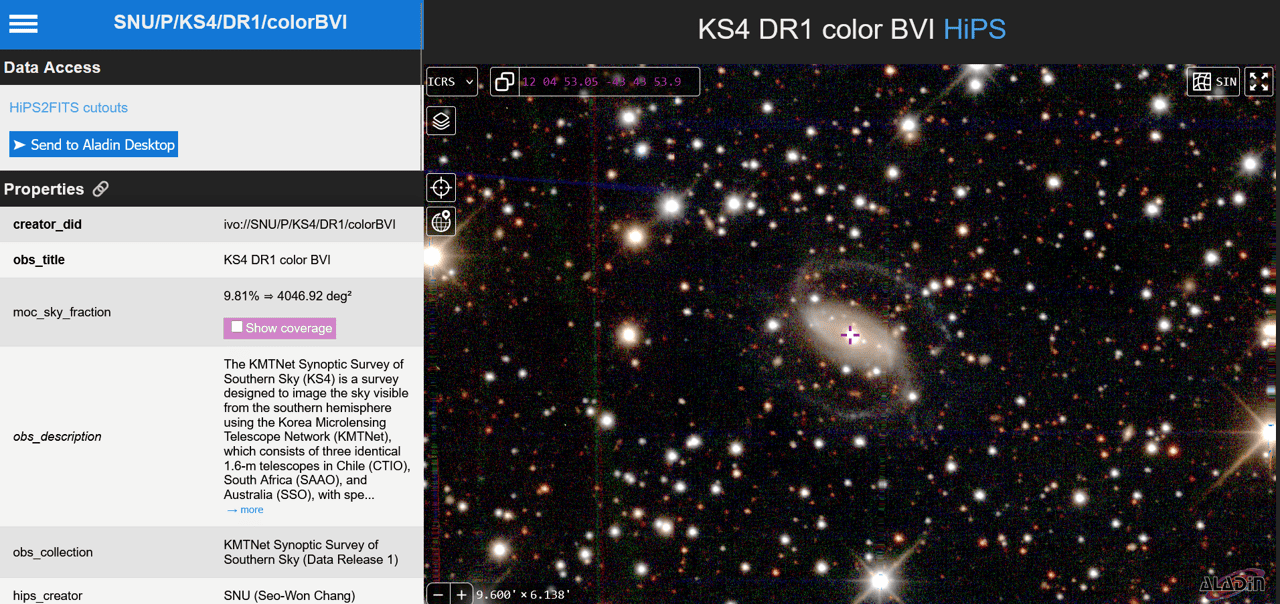
Figure: Preview of data access. Visit here to explore the data.
Data Access
The KS4 data are accessible by a variety of means:
Data Lab Table Access Protocol (TAP) service
TAP provides a convenient access layer to the KS4 catalog database. TAP-aware clients (such as TOPCAT) can point to https://datalab.noirlab.edu/tap, select the ks4_dr1 database, and see the database tables and descriptions. You can also view the KS4 tables and descriptions in the Data Lab table browser.
Data Lab Query Client
The Query Client is available as part of the Data Lab software distribution. The Query Client provides a Python API to Data Lab database services. These services include anonymous and authenticated access through synchronous or asynchronous queries of the catalog made directly to the database. Additional Data Lab services for registered users include personal database storage and storage through the Data Lab VOSpace.
The Query Client can be called from a Jupyter Notebook on the Data Lab Notebook server. Example notebooks are provided to users upon creation of their user account (register here), and are also available to browse on GitHub at https://github.com/astro-datalab/notebooks-latest.
Jupyter Notebook Server
The Data Lab Jupyter Notebook server (authenticated service) contains multiple examples of how to access and visualize the DESI catalogs and spectra:
- Getting Started with KS4 DR1
- Source Classification Guidance & Pre-matched External Catalogs in KS4 DR1
Acknowledgments
The KS4 project was supported by the National Research Foundation of Korea (NFR) grants, No. 2020R1A2C3011091, and 2021M3F7A1084525, funded by the Ministry of Science and ICT (MSIT) of Korea. The KS4 data were obtained by the KMTNet system operated by the Korea Astronomy and Space Science Institute (KASI) at three host sites of CTIO in Chile, SAAO in South Africa, and SSO in Australia. Data transfer from the host site to KASI was supported by the Korea Research Environment Open NETwork (KREONET).