We are happy to share with you the latest developments at Astro Data Lab in this January 2026 newsletter!
In this newsletter
- Astro Data Lab at AAS 247 in Phoenix, Arizona
- Insights from the first Astro Data Lab user survey
- New SPARCL release with BOSS/SDSS-DR17
- New datasets at Astro Data Lab
- New Jupyter notebooks
Astro Data Lab at AAS 247 in Phoenix, Arizona
 Astro Data Lab will be at the AAS 247 winter meeting in Phoenix, Arizona. We will have a dedicated Splinter Session "Astro Data Lab Science Platform at Eight - From Data to Discovery" on Monday January 5 from 10AM - 11:30AM in room 121B - all are welcome!
Also make sure to visit us at booth #319, grab new Data Lab postcards and buttons, and engage in discussion with team members Alice Jacques, Benjamin Weaver, Brian Merino, David Herrera, Stephanie Juneau, and Robert Nikutta about our new web portal and spectroscopy tool SPARCL. Whether you have questions about Data Lab or are interested in learning how to create your free Data Lab account, we are here to help!
Drop by booth #319 during any of the following times for a demo of the new web portal, DRAGONS, Aladin Lite, SPARCL, or any of our notebooks:
- Monday, January 5:
- 12:30pm - 1:30pm = Explore large scale structures of galaxies (EN or ES)
- 3:30pm - 4:30pm = Reduce Gemini imaging and spec data with DRAGONS v4.0.0
- 4:30pm - 5:30pm = Aladin Lite
- 5:30pm - 6:30pm = New Astro Data Lab web portal
- Tuesday, January 6:
- 9am - 10am = Aladin Lite
- 10am - 11am = Explore large scale structures of galaxies (EN or ES)
- 2pm - 3pm = Explore large scale structures of galaxies (EN or ES)
- 3:30pm - 5pm = Reduce Gemini imaging and spec data with DRAGONS v4.0.0
- Wednesday, January 7:
- 10:30am - 11:30am = Reduce Gemini imaging and spec data with DRAGONS v4.0.0
- 5:30pm - 6:30pm = Aladin Lite
- Thursday, January 8:
- 10:30am - 11:30am = Explore large scale structures of galaxies (EN or ES)
- 11:30am - 12:30pm = Reduce Gemini imaging and spec data with DRAGONS v4.0.0
- 12:30pm - 2pm = Aladin Lite
Insights from the first Astro Data Lab user survey
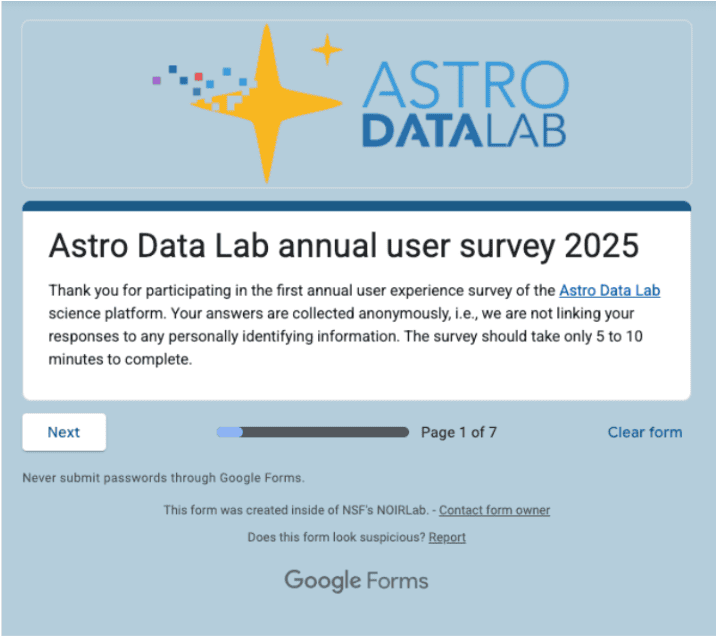 The first annual user survey for Astro Data Lab has been successfully completed, gathering insights from 71 participants between August 22 and September 30, 2025. This comprehensive survey, which included 17 varied questions ranging from open response to multiple-choice options, aimed to understand how users leverage the platform for their research, the challenges they face, and their suggestions for future enhancements. Overall, users rated their satisfaction with Data Lab at 4.33 out of 5 stars.
The survey revealed key areas for improvement, including requests for more optical, UV, and IR datasets, as well as features like an interactive sky viewer application, GPUs for ML/AI applications, and a Jupyter notebook Gallery. Additionally, while many users reported no issues with the platform, some highlighted challenges, including slow-running queries and query timeouts. These insights will be invaluable as we strive to enhance the user experience and expand our offerings in the coming years.
Figure: The first page of the inaugural Astro Data Lab user survey.
New SPARCL release with BOSS/SDSS-DR17
 A new version of the SPectra Analysis and Retrievable Catalog Lab (SPARCL) has been released, upgrading the Sloan Digital Sky Survey (SDSS) and Baryon Oscillation Spectroscopic Survey (BOSS) datasets from DR16 to DR17. Data Release 17 (DR17) is the final data release of the fourth phase of the Sloan Digital Sky Survey (SDSS-IV). The updated datasets contain 1,843,193 spectra from the SDSS instrument and 3,958,000 from BOSS for a total of 5.8 million spectra of stars, galaxies and quasars.
All science example and How-To Jupyter notebooks using SPARCL at Astro Data Lab have been updated to reflect the updated DR17 release. The How-to-use-SPARCL notebook is the recommended starting point. Example science notebooks that were updated include Comparing SDSS and DESI spectra using SPARCL and Stacking SDSS Spectra of Galaxies Selected from the BPT Diagram. Other How-To notebooks show how to interactively visualize spectra with Jdaviz and prospect.
Notes:
- The main identifier, specobjid, can vary between DR16 and DR17. Therefore, we suggest that users verify that they are using the DR17 version (available at Astro Data Lab in the sdss_dr17.specobj and sparcl.main tables).
- Users should be aware that DR17 includes an important fix to the SPECOBJID field (called specid in SPARCL): in DR16, a bug corrupted this column in the spAll catalog, and the SDSS team recommended using the PLATE-MJD-FIBERID combination instead. This issue has been resolved in DR17, restoring specid as a reliable, unique identifier for spectra.
New datasets at Astro Data Lab
DELVE DR3
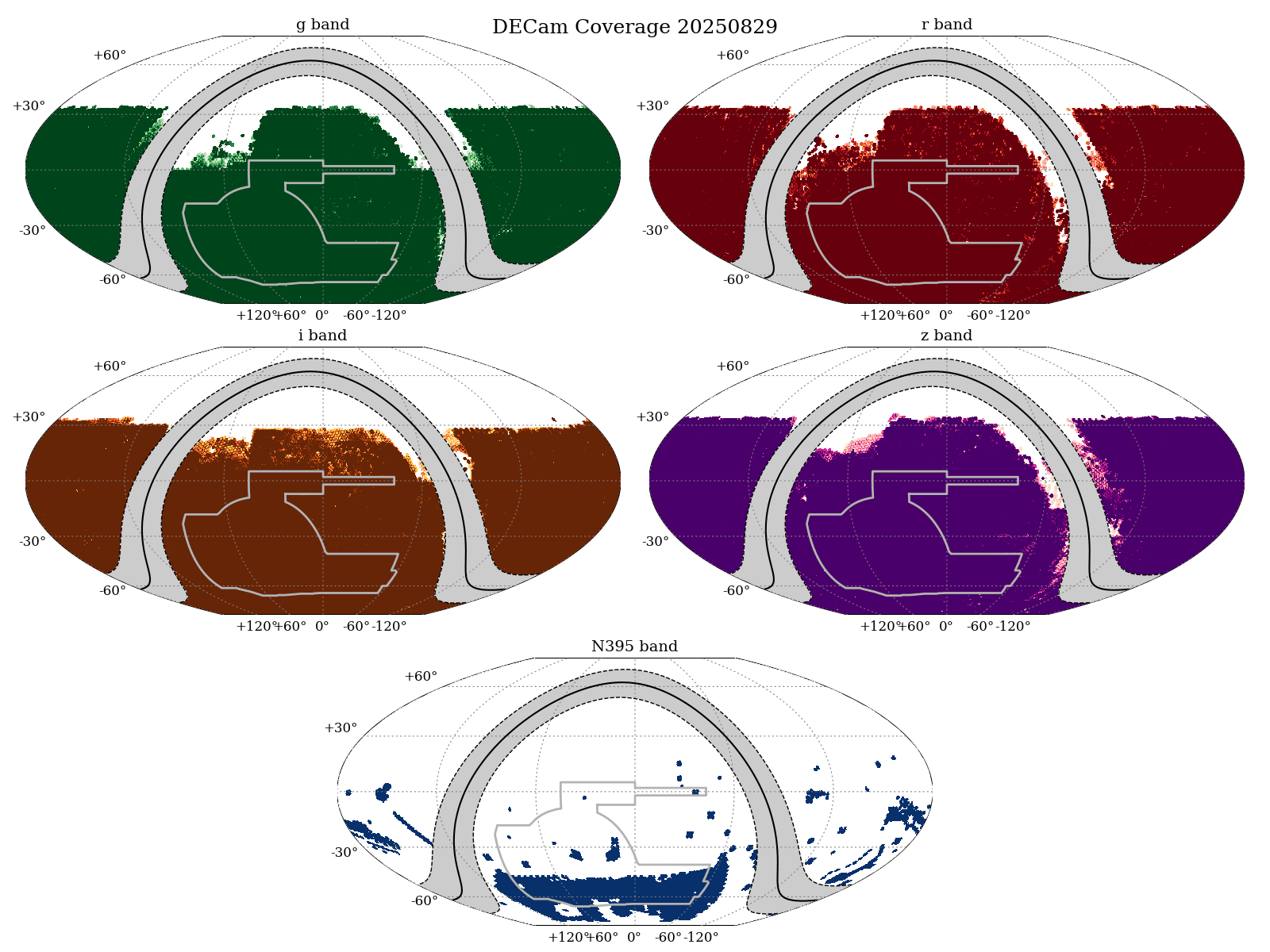
The third DELVE data release consists of coadded images and catalogs in griz from the DECam All Data Everywhere (DECADE) and DES DR2 processing at NCSA using the DES Data Management (DESDM) pipeline. The DELVE DR3 coadd object catalog contains ∼2.6 billion unique coadd objects and covers ∼20,000 deg² in all four bands simultaneously. A map of the existing DECam coverage is shown below with darker colored regions indicating more overlapping exposures. The DELVE DR3 coadd objects can be accessed through the delve_dr3.coadd_objects table.
DELVE DR3 DECADE Cosmic Shear VAC
The DECADE shear catalog is a Value-Added Catalog (VAC) that contains all DECADE shape measurements (Anbajagane et al. 2025) made on objects from DELVE DR3 coadd images, using the Metacalibration algorithm. The catalog numbers 1.3+ billion objects covering about 14,000 deg². The cosmology-ready sample is a subset of this catalog, with 170 million objects covering 9,000 deg². The latter can be selected from the raw catalog using the relevant columns. Other information, data products, including data access for bulk downloads, can also be found on the DECADE public release page.
Note: some objects in the DECADE shape catalog do not have a match in the DELVE DR3 coadd_objects table. The DR3 catalog is a combination of DELVE and DES, and in regions where both datasets produced catalogs, DR3 picks the dataset with deeper coverage. Such a combination was not performed for the shape catalog.
Legacy Surveys DR10 Point Source VACs
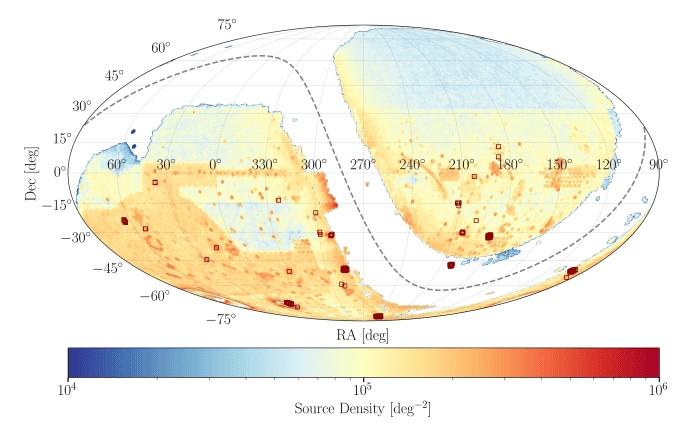 The LS DR10 Point Source Catalogs (ls_dr10.psc_n and ls_dr10.psc_s) deliver Hybrid-model classifications for over 3.1 billion LS DR10 sources, the largest resolved/unresolved catalog to date. After removing duplicates, addressing DR10 BAILOUT regions (bricks that contain LS DR9 sources with no corresponding DR10 source) in ls_dr9.bailout, and manually classifying a handful of problematic objects, each source receives an XGBoost score with a recommended threshold of 0.5. Crossmatching with Gaia DR3 improves stellar identification, recovering about 5 million misclassified stars. In total, the catalog identifies 466 million point sources, roughly 15% of all entries.
Figure: The source density map of LS-PSC from Liu et al. 2025. The red boxes indicate the bricks containing sources labeled as bailout. The actual size of the bricks (~0.25 deg x 0.25 deg) is much smaller than the box size. The dash line marks the Galactic plane. The source density in the northern footprint (covered by BASS and MzLS) is significantly lower than that in the south (covered by DECam-based programs such as DECaLS and DES).
DESI DR1 Milky Way Survey VAC
The desi_dr1.mws Value-Added Catalog (VAC) features stellar spectral measurements from DESI DR1 data, processed by the RVSpecFit (RVS) and FERRE (SP) pipelines. Objects were selected based on criteria like classification as stars, low redshift, or targeting as spectrophotometric standards. The RVS pipeline uses PHOENIX templates to obtain radial velocities and stellar parameters, while the SP pipeline models stellar abundances using PHOENIX and Kurucz atmospheres. Notable improvements include the use of neural networks for stellar parameter estimation. Key statistics include 6.37 million coadded spectra, 4.59 million spectroscopically classified stars, and over 10 million single-epoch measurements. The release includes stellar parameters, radial velocities, and combined catalogs grouped by survey/program, with crossmatches to Gaia DR3 via the source_id column. For more information and proper acknowledgments, please visit our DESI landing page.
KS4 DR1
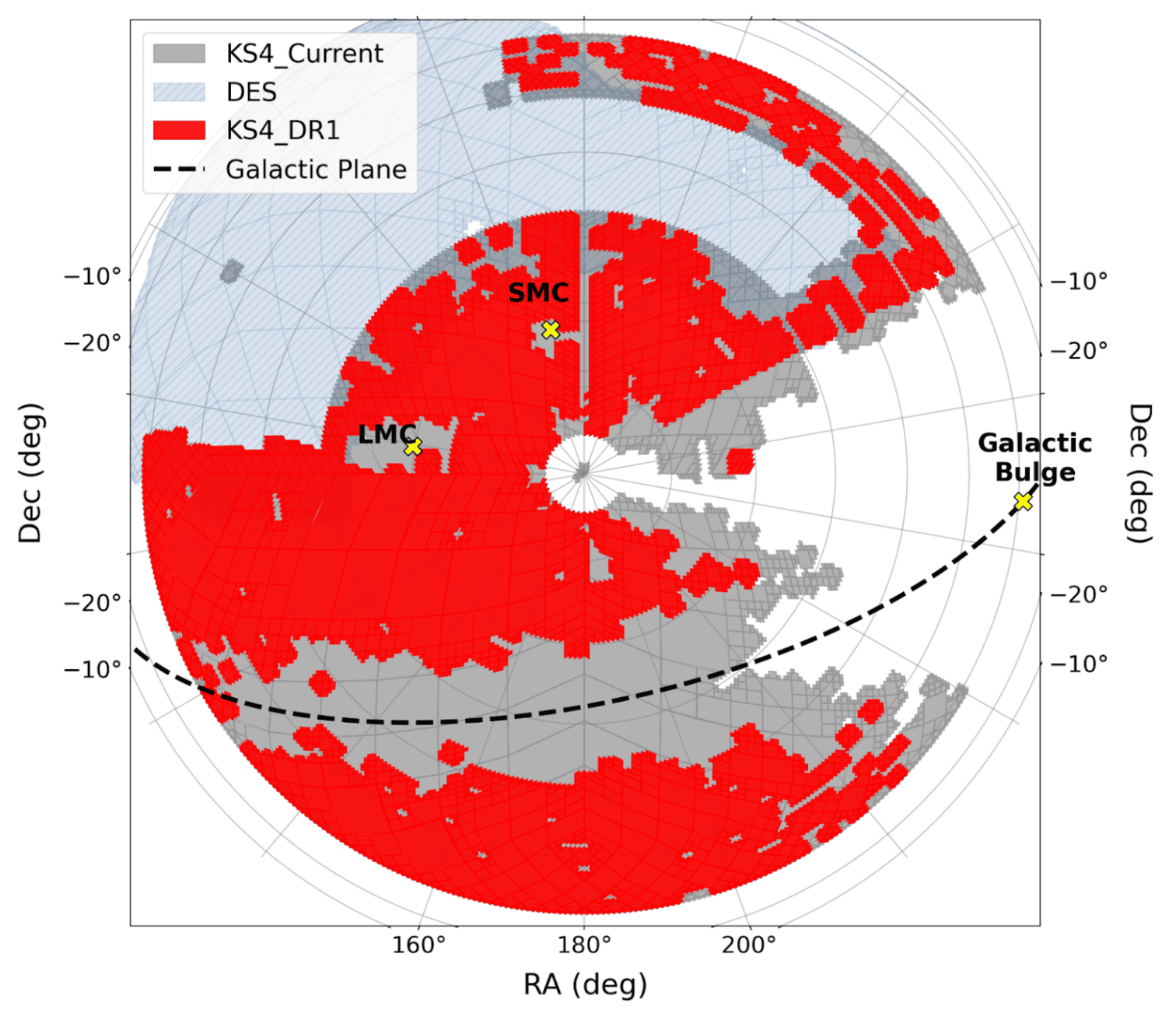 The first public data release (DR1) of the KMTNet Synoptic Survey of Southern Sky (KS4) is now available at Data Lab. KS4 is a deep imaging survey taken with four bands (B, V, R, I) that covers the southern hemisphere (-85° < Dec < -28.8°). KS4 was conducted using the Korea Microlensing Telescope Network (KMTNet), which consists of three identical 1.6-m telescopes located at Cerro Tololo Inter-American Observatory (CTIO) in Chile, South African Astronomical Observatory (SAAO) in South Africa, and Siding Spring Observatory (SSO) in Australia. This survey contains 279 million objects reaching a 5σ limiting magnitude of 22-23.5. The survey consists of two tables: ks4_dr1.idual_master, I-band selected forced-photometry optimized for consistent color measurements, and ks4_dr1.single_master, a band-merged catalog based on independent detections in each filter for enhanced completeness. For more information on the KS4 survey, visit the KS4 landing page at Data Lab.
Figure: Multi-Order Coverage map of the KS4 DR1 sky coverage, presented in a polar projection centered on the South Celestial Pole (Dec = -90°).
eBOSS-DAP VAC
The eBOSS Data Analysis Pipeline (eBOSS-DAP) is a Value-Added Catalog for SDSS DR17 providing uniform, high-quality spectroscopic measurements for the eBOSS galaxy sample. Adapted from the MaNGA-DAP, it delivers emission-line fluxes and equivalent widths, stellar and gas kinematics, continuum spectral indices, and stellar population fits (Matthews Acuña et al. 2025). Using this pipeline, the team analyzed approximately two million galaxy spectra that passed quality cuts, spanning a redshift range of 0.0005 < z < 1.12. The resulting tables offer a comprehensive spectroscopic dataset designed to fully leverage the scientific potential of eBOSS. There are four tables included in this VAC: sdss_dr17.eboss_dap_emlines, sdss_dr17.eboss_dap_emlines_high_ew, sdss_dr17.eboss_dap_spind, and sdss_dr17.eboss_dap_tplwgt. For more information about these tables visit our SDSS DR17 landing page.
────────────────────
Data Lab cross-matched tables
The Data Lab team has already cross-matched the KS4 DR1 "idual_master" and "single_master" tables with our reference datasets: Gaia DR3 (for astrometry), AllWISE, NSC DR2, and unWISE DR1 (for photometry), and vice versa. These KS4 tables have also been crossmatched with SkyMapper DR4, VHS DR5, and DELVE DR2 from the request of the data providers. We have also added a few other useful columns such as nest4096, ring256, and htm9 for sky tessellation use cases. The pre-crossmatched tables are accessible in the Catalogs section of the Data Explorer, and through standard TAP/SQL/ADQL queries, like all other catalogs at Data Lab.
Dataset requests
The Data Lab team evaluates periodically which external survey datasets we should source, ingest, and serve. We appreciate requests and suggestions from our users. Please contact us at datalab@noirlab.edu to send your request and, if possible, mention an example scientific use case.
New Jupyter notebooks
Several new notebooks were recently added to Data Lab's extensive collection of notebooks for our user community:
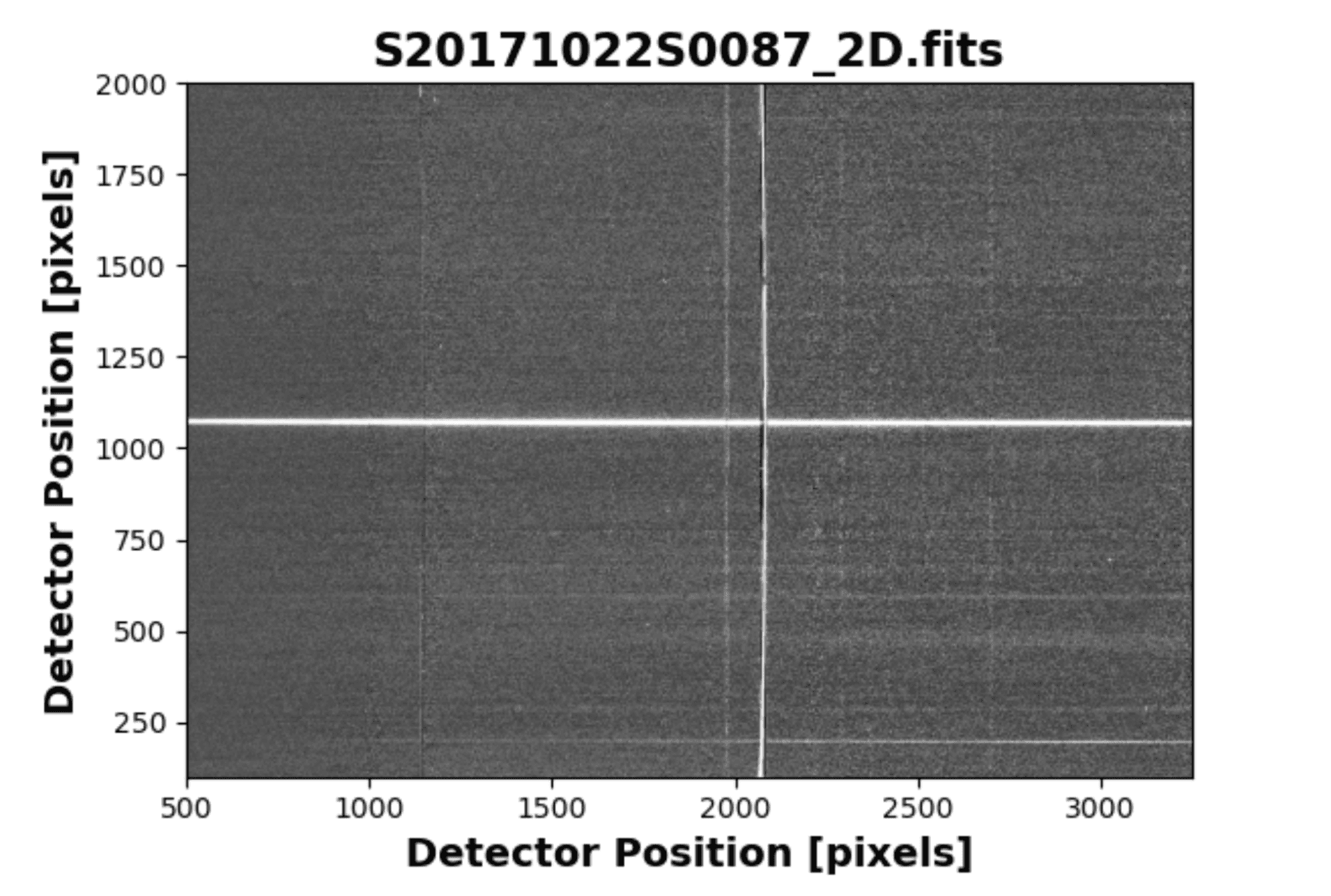
Gemini L-band Longslit Point Source reduction using DRAGONS Python API
 Author: Brian Merino
A new GNIRS reduction tutorial has been added to Data Lab. This notebook uses the new DRAGONS-4.0.0 (DL, Py3.12) kernel to reduce GNIRS longslit L-band data for the Be star "HD41335". The tutorial will demonstrate how to download the data directly from the Gemini Observation Archive, then use the DRAGONS Application Program Interface (API) to set up the calibration manager, process the calibration and science data, and display the final reduced 1D spectrum.
Figure: Reduced 2D spectrum of the candidate DB white dwarf J2145+0031.
Using the DESI AGN/QSO Value-Added Catalog
Authors: Andy Morgan, Stephanie Juneau

The DESI AGN/QSO Value-Added Catalog tutorial, found at https://data.desi.lbl.gov/doc/releases/dr1/vac/agnqso/, has been adapted for the Astro Data Lab platform. The VAC includes all extragalactic targets (redshift z>0.001) from DESI DR1. The notebook teaches users how to retrieve objects and decode their classification bitmasks, corresponding to different Active Galactic Nuclei (AGN) emission line and color diagnostics, such as the WISE color classification shown in the figure.
Figure: WISE color classification denoted as in Assef et al. (2018), separating AGN (in red; left-hand panel) from star-forming galaxies (in blue; right-hand panel) according to their positions in WISE color-magnitude space. Grey contours delineate the full distribution.
Generating MOCs with Aladin Lite v3
 Author: Brian Merino
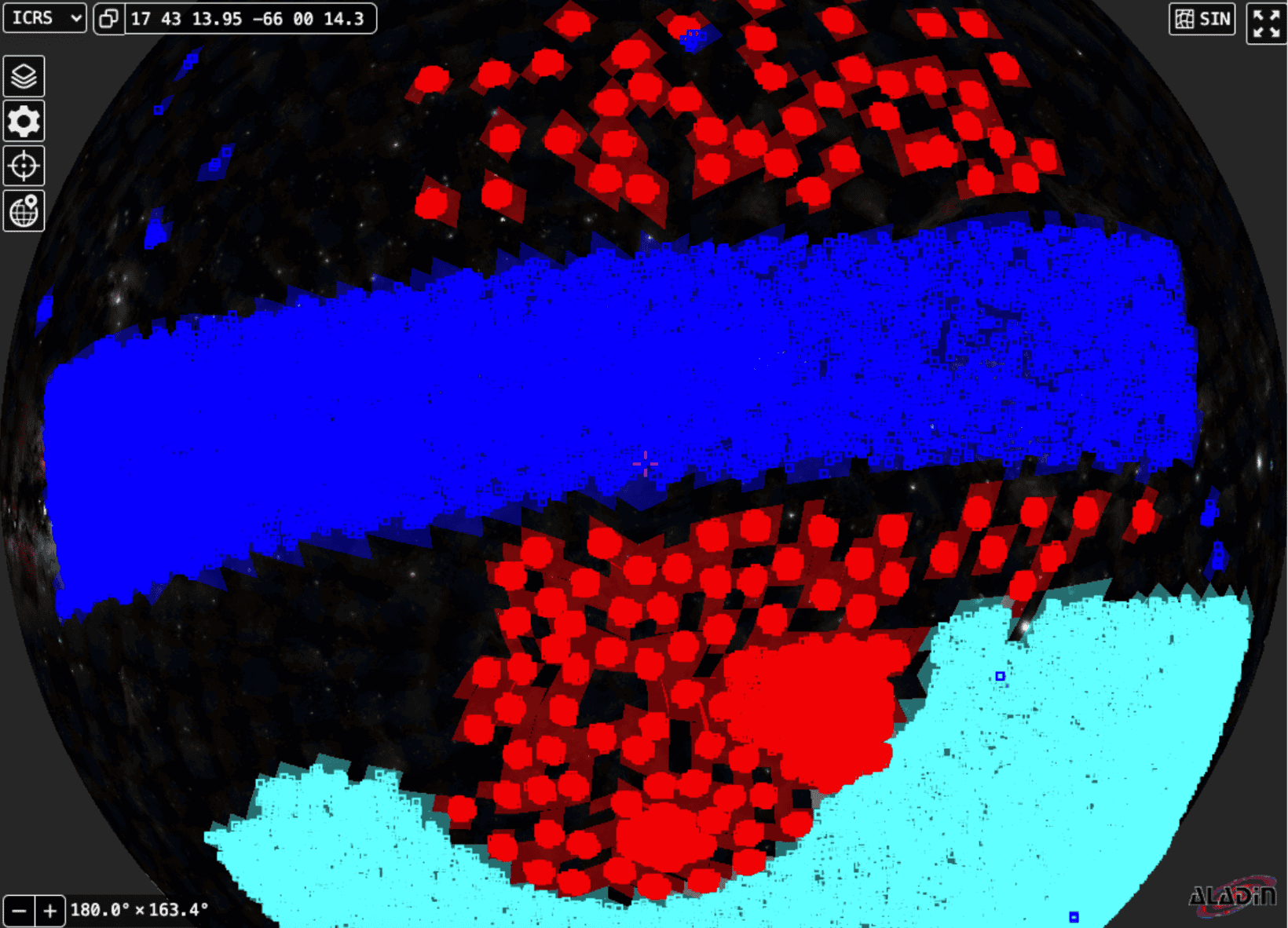
A new way to visualize datasets has been added to the Data Lab Jupyter notebook collection. The ipyaladin_moc notebook uses ipyaladin, which allows Jupyter notebooks to utilize Aladin Lite's functionality from within the notebook to display the footprints of the des_dr2.main, smash_dr2.object, and decaps_dr2.object tables. The notebook shows you how to query datasets hosted by Data Lab, generate Multi-Order Coverage (MOCs) maps for the data, and display the MOCs in Aladin.
Figure: Multi-Order Coverage (MOCs) maps created for des_dr2.main (cyan), smash_dr2.object (red), and decaps_dr2.object (dark blue) tables displayed with the Aladin Lite viewer. Displaying MOCs like this helps visualize which parts of the sky each survey hosted by the Data Lab covers.
Displaying images and catalogs with Aladin Lite v3
 Author: Brian Merino
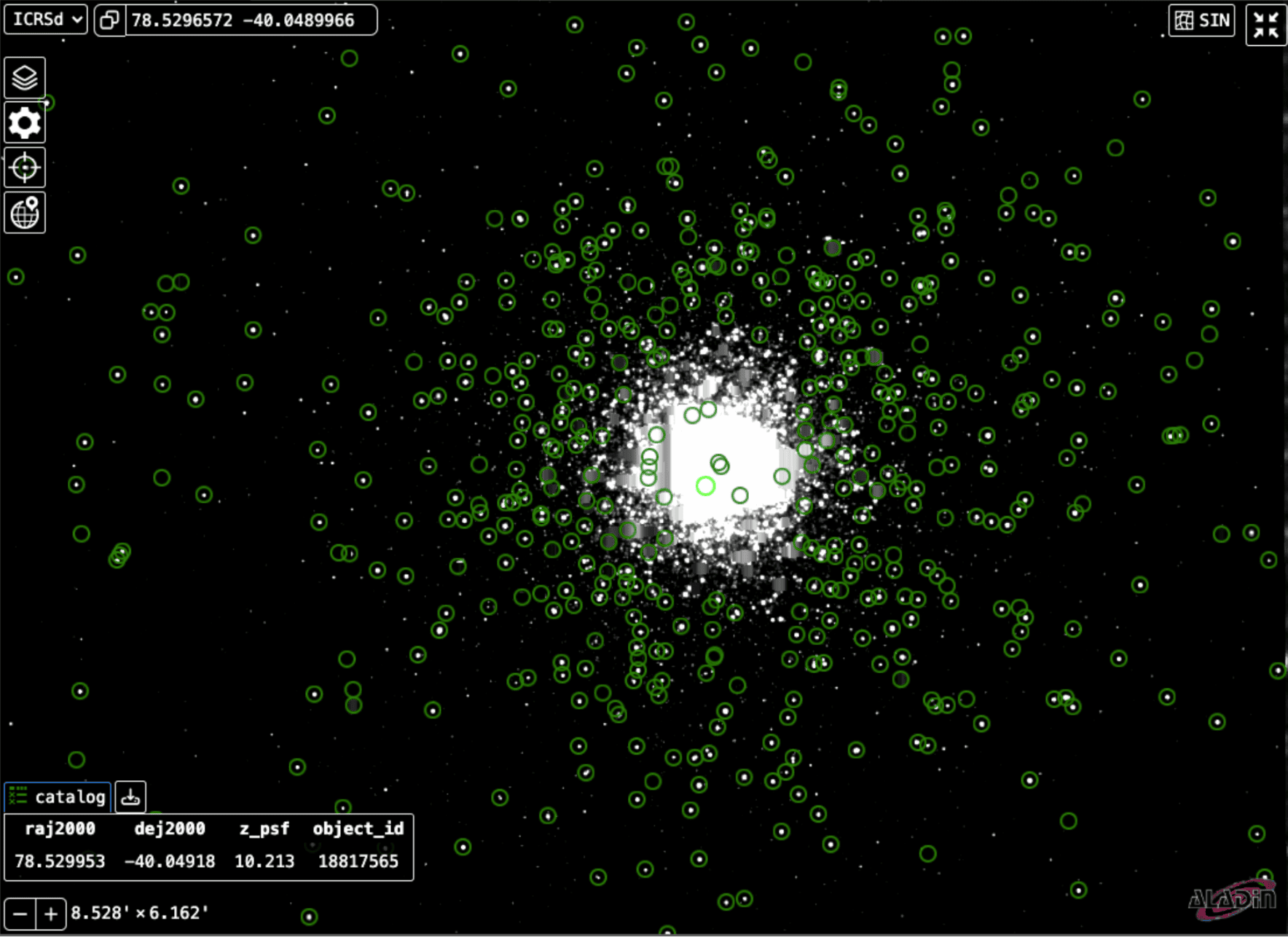
Another notebook that uses Aladin Lite has been made available at Data Lab. The ipyaladin_globular_cluster notebook demonstrates how to initialize and modify the Aladin Lite viewer from within your notebook. Then it will demonstrate how to use the SIA service tool to get image cutouts of the globular cluster NGC 1851. The notebook will then explain how to take these cutouts and display them directly in the Aladin viewer. Next, the notebook queries the skymapper_dr4.master table for photometric data that will be used to create a color-magnitude diagram of the cluster.
Figure: Data from skymapper_dr4.master overplotted on the globular cluster NGC 1851 with Aladin Lite. The interactive viewer lets you pan across the sky and interact with each data point.
Contact us
You can visit our website, use the helpdesk, reach us via email at datalab@noirlab.edu, and follow us on BlueSky.
Edited by Alice Jacques